
A model for where I live
A forecasting model for Illinois' Unemployment Rate and local concerns


I live in Lake County, Illinois, just north of Chicago. That fact hasn’t mattered for the past six years — except at tax time and whenever I look at that obscene property tax bill (obscene in the old sense: indecent, an offense to good morals, perverse).
I’ve worked either remotely or from home since moving here a month before COVID. I’m not from here, and my daily wanderings to Walgreens, Target, and the occasional restaurant (McDonald’s) do not exactly immerse me in the local culture.
None of the work I do “contributes” to the local economy. I’m pretty sure I’ve single-handedly put the Dominos guy’s kid through college, but that’s via my consumption, not my labor.
I’ve never worked for a company with a local focus. Why would you hire a data scientist if 1-5% revenue increases wouldn’t justify the salary? You can’t make a product good enough via data science. You can only make it better once it’s good enough. You’ve got to see some action…
All of which is to say, I have very little connection to where I live—and this is the place I’ve lived the longest since leaving home! Six years! I don’t keep up with local politics or have opinions on the Parks District race. But I want to! I like living here. It’s lovely for one thing, and there are rabbits that follow me around whenever I go outside (because I give them food).

A subspecies of science fiction talks about this. Disconnection from the physical. Folks augment themselves with machines, becoming human-shaped Ships of Theseus, severing the self from the body and the physical environment. The protagonist does this to himself in search of security, riches, respect, or meaning, but it causes problems. The writers solve these problems in different ways, but part of the solution typically involves an attractive woman with a katana, some unresolved issue with her dead father, and an alternative aesthetic. She reminds him of what it means to be human. That there’s some flesh you don’t want to part with even for cybernetic glory…
Okay, I’m stretching the analogy. What I’m trying to say is that I think it’d be good if where I lived affected what I do in some small way. So, I think I’ve got a solution...
Forecasting models.
Hear me out:
Respectable people forecast the national accounts, unemployment rates, inflation rates, etc. They put vast sums of money on the line, betting on how those series will move. We pay less attention to local forecasts, which, as far as I can tell, are primarily generated by a city or state paying some consulting company to do it.
The kind of person who would execute a weekend project to forecast local economic conditions, without hope of financial reward, clearly could not be called rootless. No, he would have to be very attached. A pillar of the community, even. You see my plan.
So, I started this project that I’m calling ZILCAST, Zach’s Illinois Forecasts, to forecast various things of local concern to Illinois and the Chicago area. I started with the Illinois Unemployment Rate because it’s an easy series to understand and build my model on, but the goal is to expand this to local series that are a bit off the beaten path.
The mathematical idea is to create solid local forecasts using a kernel-weighting strategy that borrows data from similar locales, reducing forecasting error from otherwise noisy series. It also uses (frequentist) model averaging to average over different model types, lag structures, and bandwidth selection strategies.
I’ll write up more about the statistical method at some point, but I put it all together technically over the last few weekends. You can watch my forecasts evolve, fail, and succeed here: https://zflynn.com/zilcast. The forecasts and actuals for the Illinois Unemployment Rate will update as the BLS posts more data.
The tech stack is simple but fun. I wrote the whole workflow from fetching the data to running the fancy regressions in R, which I think has been devalued far too quickly in tech-land, but that’s another post. I run the actual forecasting on AWS because it’s fairly computationally-intensive, but the whole thing is “orchestrated” via cron jobs running on my laptop. I archive the results on this tiny Postgres box I use for all my side projects.
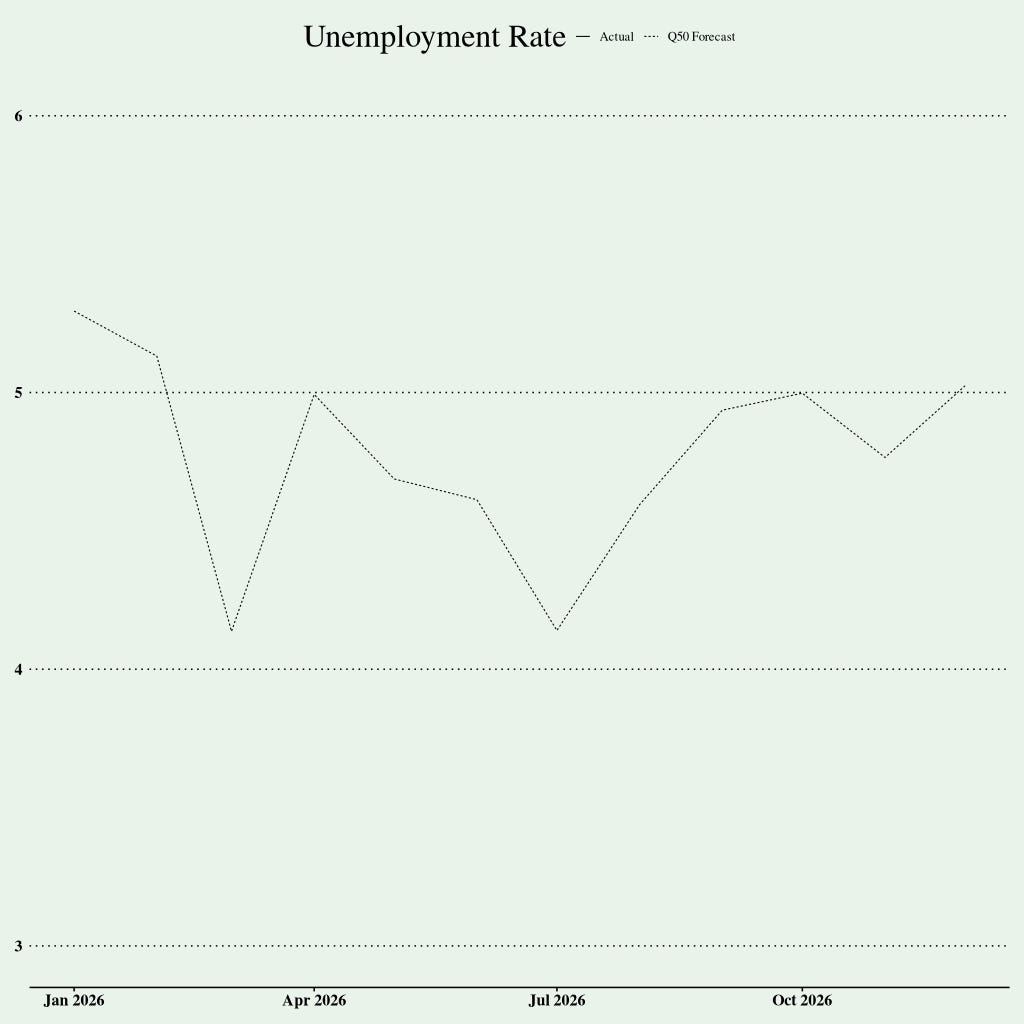
Here’s the current median forecast for 2026 (the latest available data is December 2025; it should update soon with January 2026 actuals).
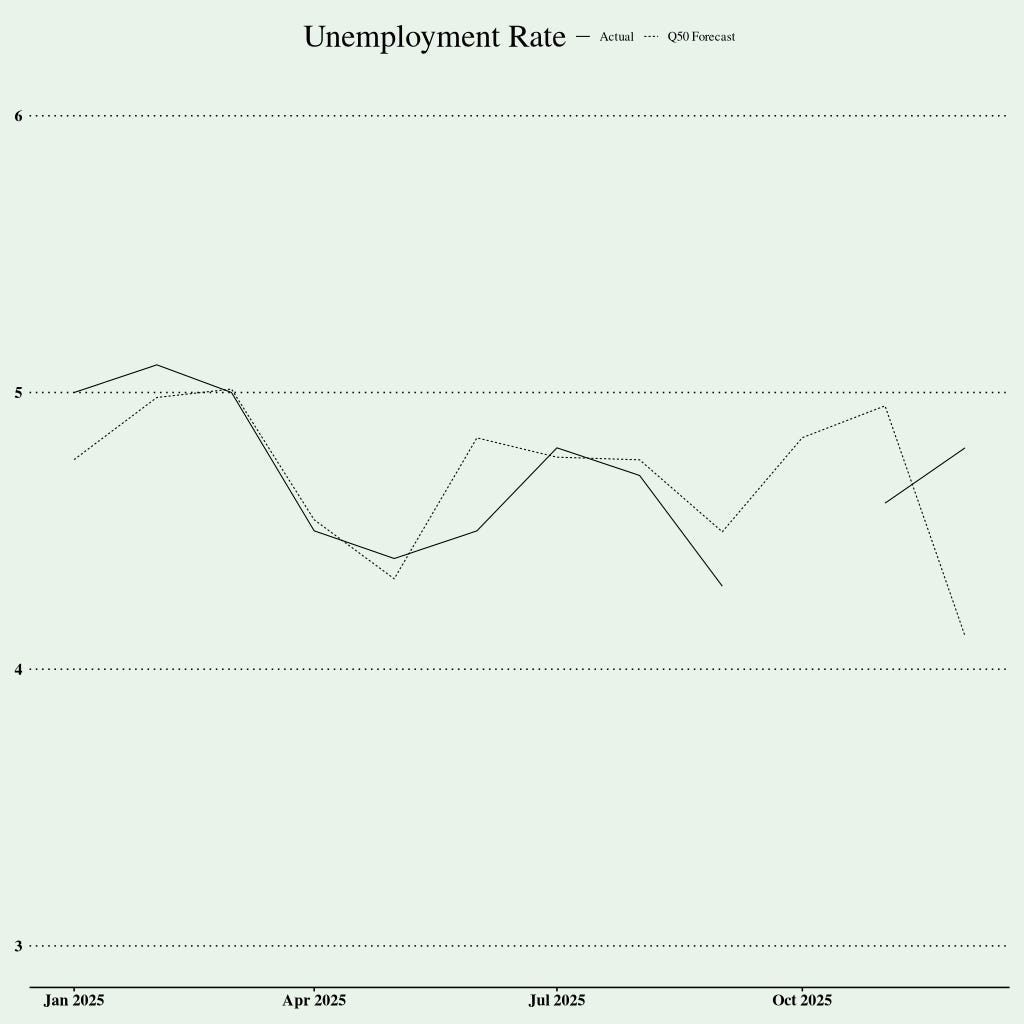
It would have absolutely crushed in 2025, except at the end. You should always be skeptical of backtests, but the forecast below is from data up to December 2024. The gap in the series is because the BLS didn’t produce the data for October 2025 because of the budget “issue”.
Anyway, I hope my little attempt to connect to where I live via fancy regressions is useful to at least a few people! Check it out at https://zflynn.com/zilcast.
Thanks for reading!
Zach
I’m on LinkedIn at: https://linkedin.com/in/zlflynn
And I have a normal, personal website at: https://zflynn.com
PS. If you’re a local government that’d like a forecast like this for planning, etc, feel free to reach out. I’m looking at what would be most useful to add to the site.